
Inside the Scotts Bluff County Most Wanted Program
Scotts Bluff County has no Most Wanted page. Neither the Sheriff nor any city police department in Scotts Bluff County publishes a titled roster, a named list, a reward table, or an update schedule. What the county does offer is the Zuercher portal's public Warrant category, which the city's own official pages describe as all current warrants in Scotts Bluff County. That is a countywide warrant search, not a curated priority program with rankings or rewards. The distinction matters. Treat the portal as a general active warrant list and nothing more.
What the Scotts Bluff Portal Offers
For a practical warrant lookup, the official warrant portal is the public route. Its current setup lets you search by name, age, charge, and bond amount, and it hides juveniles. It shows no refresh schedule and no priority ranking. Use it to check your own record or to help a family member find the right court in Scotts Bluff County. If a possible match appears, confirm with County Court, District Court, or the Sheriff before acting on it. Don't save or mirror a result row as a public roster.
How Scotts Bluff Most Wanted Lists Work
Scotts Bluff County posts no published rules for a most-wanted list and keeps no set update schedule for one. If the county ever launches such a program, its own page will spell out who gets listed, how tips come in, whether rewards apply, when the list is refreshed, and how names come off. Until that happens, treat a current-warrant roster and a most-wanted roster as two different things. The county Public Notices page is worth rechecking for word of any future program. Nebraska Judicial Branch once announced a Lincoln night-court and amnesty event, and that announcement is an official state example, but it is not a Scotts Bluff County program.
Reporting a Scotts Bluff Tip Safely
The Scotts Bluff County sheriff's tip portal has a Submit a Tip option, and the phone directory lists Crime Stoppers at 308-632-7867. Those channels exist for public-safety information, nothing else. A tip form is not the way to ask whether you have an active warrant, pull a court document, or have a warrant recalled. Take those questions to the issuing court instead.
Tip boundary: Share only what the official channel asks for. For your own case, call the issuing court or Sheriff Warrant Division instead.
That anti-scam notice points to the official Nebraska Judicial Branch warning. It covers fraud alerts only. Scotts Bluff County readers will find no person or warrant roster there.
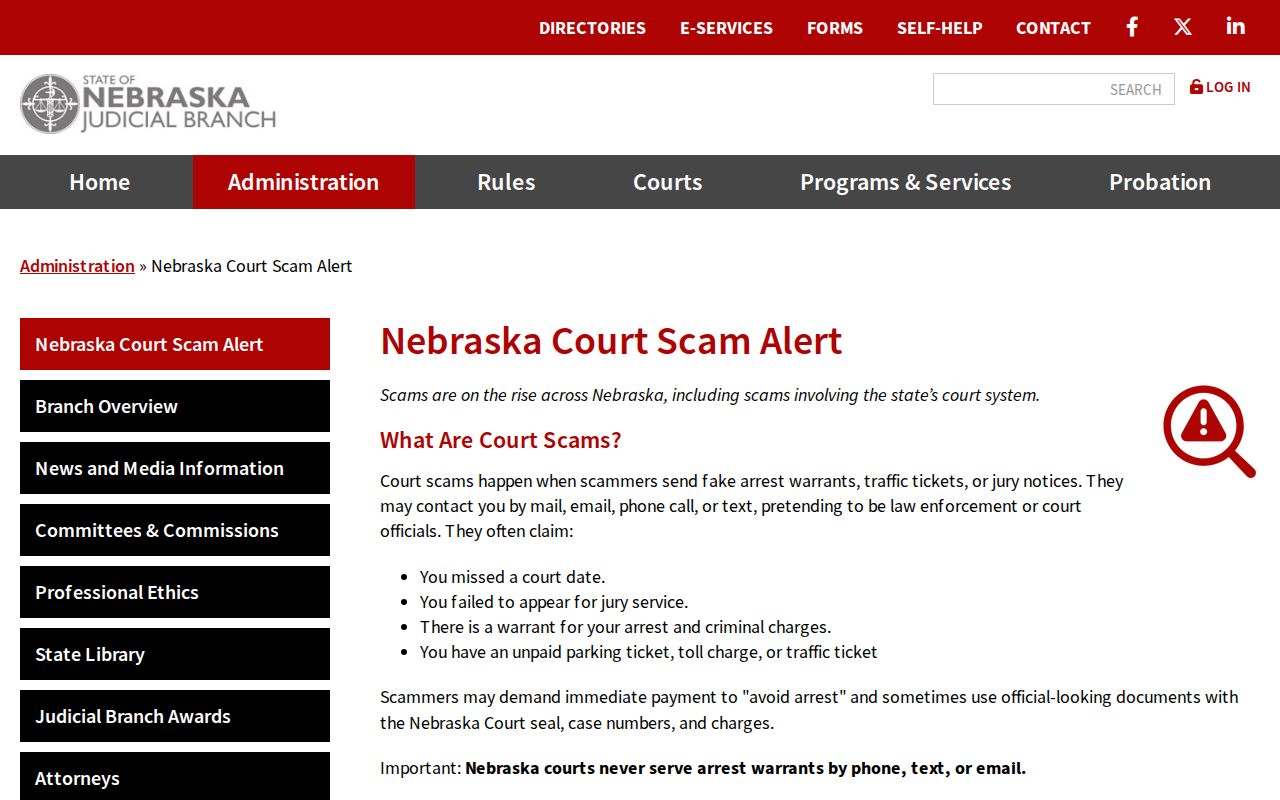
Courts in Scotts Bluff County never serve arrest warrants by phone, text, or email, and they never demand digital-wallet payment.
Most Wanted and Active Warrants
An active county warrant list and a curated most-wanted roster would serve different purposes. The Scotts Bluff County portal is described as all current warrants and shows no ranking, reward, or priority field. A future program could highlight a subset. But no such official local roster exists in Scotts Bluff County today.
| Question | County warrant portal | Curated most-wanted program |
|---|---|---|
| Scope | Countywide public warrant search/list | Selected subset if an agency creates one |
| Ranking | No public priority label located | Program rules would need to say how selection works |
| Rewards | No local reward terms found | Only an official program could set terms |
| Personal status | Confirm with court or Sheriff | Never infer status from a copied post |
How to Check Your Own Record
Open the county portal and use the Warrant category, reading only the fields needed to route your question. Then call County Court for traffic, city ordinance, misdemeanor, or preliminary felony matters. District Court holds filed felony records. The Sheriff Warrant Division handles service and extradition questions. Nebraska JUSTICE can show public case entries for Scotts Bluff County, though it is not a live warrant database. A missing result can reflect juvenile, sealed, protected, newly issued, or timing limits.
Confirming a County Portal Record
Ask which court issued the order, whether it remains active, and what the court requires next. County Court sits at 1725 10th Street, first level, Gering, and District Court is at the same address on the second level. Sheriff administration is at 1825 10th Street, while detention and bond questions go to 2522 7th Street. Each office answers something different. The court controls recall and appearance. The Sheriff handles operational warrant administration, and detention answers current custody, charges, and bond within its published limits. A public portal cannot replace any of those Scotts Bluff County roles.
When You Believe You Are Listed
Don't approach an online roster or contact a stranger named in a post. If the concern is your own record, call the issuing court in Scotts Bluff County and ask for the lawful next step. Talk with counsel about surrender, recall, bond, or another court response. The Sheriff can confirm routing but cannot recall a judge's order.
Use official contacts. A copied name, photo, or social post is not a court record and is not a safe basis for a legal decision.
Scotts Bluff County Tip and Court Roles
A tip can move public-safety details to the right desk in Scotts Bluff County, but that is all it does. It opens no court file, lifts no warrant, and schedules no hearing. For procedure questions, call the clerk of the issuing court; the Sheriff's warrant unit handles its own routing, and Detention takes custody and bond questions. Want paper records? File the county's FOI request route no wait, use the official FOI request route, asking for public, non-sealed portions, and expect a fee estimate or redaction.
Federal Most Wanted Boundaries
A Scotts Bluff County portal cannot confirm federal warrant status. The detention center holds a U.S. Marshals contract, but that covers custody arrangements, not a federal warrant roster. Federal cases sit with the U.S. District Court for the District of Nebraska, with PACER, or with the U.S. Marshals Service. A county tip line cannot resolve one. Route any federal matter through the named authority or your counsel.